Most business advisors will tell you to build a website. Not just any website a real one, with a homepage, an about page, a services section, a blog, a contact form, maybe a testimonials page, and, if you're really serious, a portfolio or case studies section. The implicit promise is that more pages signal professionalism, that breadth equals credibility, and that the more Google has to index, the higher you'll rank.
But somewhere in that advice is a quiet assumption nobody questions: that your customers actually want to navigate a miniature website to find a phone number, or that a sprawling digital presence somehow serves them better than a single, clear place to act.
The contrarian read on single-page business hubs suggests the opposite that condensing your business into one focused profile, with every link, booking option, and payment method organized in one spot, isn't a compromise at all. It's a competitive advantage.
What Is a Single-Page Business Hub?
A single-page business hub is exactly what it sounds like: one web address that serves as the central nervous system for how customers find, contact, and transact with a business. Instead of spreading information across multiple pages each requiring its own navigation, load time, and maintenance a hub consolidates everything into one organized profile.
Platforms like PageCash's one-page business hub approach illustrate the model clearly. Rather than asking customers to click through a traditional website, a hub brings links, booking forms, payment options, FAQs, and proof of credibility into a single view. The PageCash model organizes these elements into three clean stages: Find (collecting public links and facts people already use to understand you), Clean (presenting one profile with actions first and clutter removed), and Share (distributing one short link everywhere).
This structure serves customers directly. Someone who discovers your business on social media, through a search result, or via a recommendation can land on your hub and immediately pay, book, order, contact, or verify without hunting through navigation menus or filling out contact forms that may never be read.
The Contrarian Case: Why More Pages Isn't Better
The standard advice to build a multi-page website emerged from a particular era of web design, when search engines rewarded content volume and when customers were accustomed to browsing. That era isn't entirely over, but it's evolving in ways that make the conventional wisdom worth questioning.
Consider what modern search engines and AI systems actually do when they evaluate a business online. They're not reading your site the way a human would, scrolling through paragraphs and admiring your photography. They're parsing structured data, evaluating the clarity of your business information, and trying to determine whether your answers match what searchers are actually looking for.
A sprawling website with hundreds of pages of thin content can actually hurt you in this environment. It dilutes your topical authority, creates maintenance burdens that lead to outdated information, and gives search systems more places to find conflicting or inconsistent data. A single-page hub, by contrast, concentrates everything. There's one place for AI to read your business facts. One place for customers to verify your contact details. One canonical source of truth that you can keep current without managing a complex site architecture.
The PageCash platform explicitly frames this as a benefit: "Your PageCash profile gives people a current place to act, while structured data, sitemaps, and AI-readable files help systems find the right facts." This isn't just a design philosophy it's a technical approach that acknowledges how modern discovery systems work.
What Should Be Included on a Single-Page Business Hub?
The strength of a single-page hub depends entirely on what you put on it. The goal isn't minimalism for its own sake it's intentionality. Every element should earn its place by helping a customer take a meaningful action.
Based on how hub platforms are structured, a complete single-page business profile typically includes:
- Payment options: The ability to pay for products or services directly, or to leave a tip. This removes the friction of having to invoice separately or wait for a check to arrive.
- Booking functionality: A way to schedule appointments or reserve services without back-and-forth email chains.
- Contact information: Phone, email, physical address, or messaging options verified and current.
- Trusted links and FAQs: Answers to common questions, along with links to social profiles, reviews, or other proof of credibility.
- Clear calls to action: The most important next step you want customers to take should be immediately visible without scrolling.
The key principle is actions first. Unlike a traditional website, where the homepage is often a billboard for everything you do, a hub should lead with what customers can do right now. A service provider's hub might lead with a booking button and pricing, followed by a brief description of what to expect. A product-based business might lead with a payment option and order form, followed by details about shipping and returns.
This prioritization isn't just good design it's good business. When you force yourself to fit everything on one page, you make hard choices about what actually matters. And those hard choices often lead to clearer communication than a sprawling site where important information is buried three levels deep.
Are Single-Page Websites Good for SEO?
This is where the contrarian case gets interesting and where many business owners hesitate. The conventional wisdom holds that more pages mean more indexed content, more keyword opportunities, and therefore better search visibility. But this wisdom is increasingly outdated.
Modern SEO is less about keyword density across dozens of pages and more about entity clarity, structured data, and user satisfaction signals. Google's algorithms have grown sophisticated enough to evaluate whether your business provides clear, consistent answers to searcher questions regardless of whether those answers live on one page or twenty.
In fact, there are several ways a single-page hub can outperform a sprawling website in search:
Better entity clarity. When all your business information lives on one page, it's easier for search engines to understand who you are, what you do, and how to reach you. Structured data markup (schema.org vocabulary) is simpler to implement correctly on a single page, reducing the risk of conflicting information across different parts of your site.
Higher engagement signals. If customers can take action directly from your hub booking an appointment, making a payment, sending a message they're less likely to bounce back to search results and try a competitor. Lower bounce rates and higher engagement can positively influence search rankings, regardless of how many pages your site has.
Easier maintenance. Outdated information on a sprawling website can confuse both customers and search engines. When you manage everything from one profile, it's simpler to keep your hours, pricing, and contact information current. Search engines reward freshness and accuracy.
The PageCash model explicitly addresses this by building AI-readable files and sitemaps into the hub itself. Rather than requiring business owners to manually configure technical SEO elements across multiple pages, the platform handles structured data and discovery files automatically. This approach acknowledges that search visibility isn't about page count it's about clarity, consistency, and technical correctness.
How to Create a Single-Page Business Hub
Building a single-page hub is simpler than building a traditional website, but that simplicity requires discipline. The process typically follows three stages:
1. Audit Your Current Digital Presence
Before you build your hub, take stock of where your business currently lives online. List every link, platform, and tool you use: your social media profiles, your booking system, your payment processor, your review profiles, your email newsletter signup. The goal is to identify everything that exists scattered across the web and bring it into one organized view.
2. Choose a Platform That Consolidates Rather Than Replaces
The best single-page hubs don't ask you to abandon your existing tools they integrate them. Platforms like PageCash explicitly position themselves this way: "Keep every tool you already use." Your hub becomes a unified front end that connects to the systems you're already running. You don't need to switch payment processors or abandon your preferred scheduling software. The hub simply provides one link to rule them all.
When evaluating platforms, look for:
- Support for the actions your customers need most (payments, bookings, contact)
- Custom domain options so your hub feels professional (e.g., yourname.page.cash)
- Structured data and sitemap generation for search visibility
- Mobile optimization, since most customers will access your hub from their phones
3. Design for Action, Not Decoration
Resist the temptation to fill your hub with decorative content that doesn't serve a purpose. Instead, organize every element around a single question: what should this visitor do next? Your most important call to action should be above the fold. Supporting information can appear below, but keep it concise and purposeful.
Include the links and information that actually help customers verify your legitimacy: a link to your Google Business Profile, customer reviews, professional certifications, or media mentions. These function as proof points that build trust without requiring lengthy written testimonials or case studies.
Platforms for Building a One-Page Business Hub
While single-page hubs are less common than traditional website builders, the market is growing as more businesses recognize the value of consolidation. Here's a rough overview of the options available:
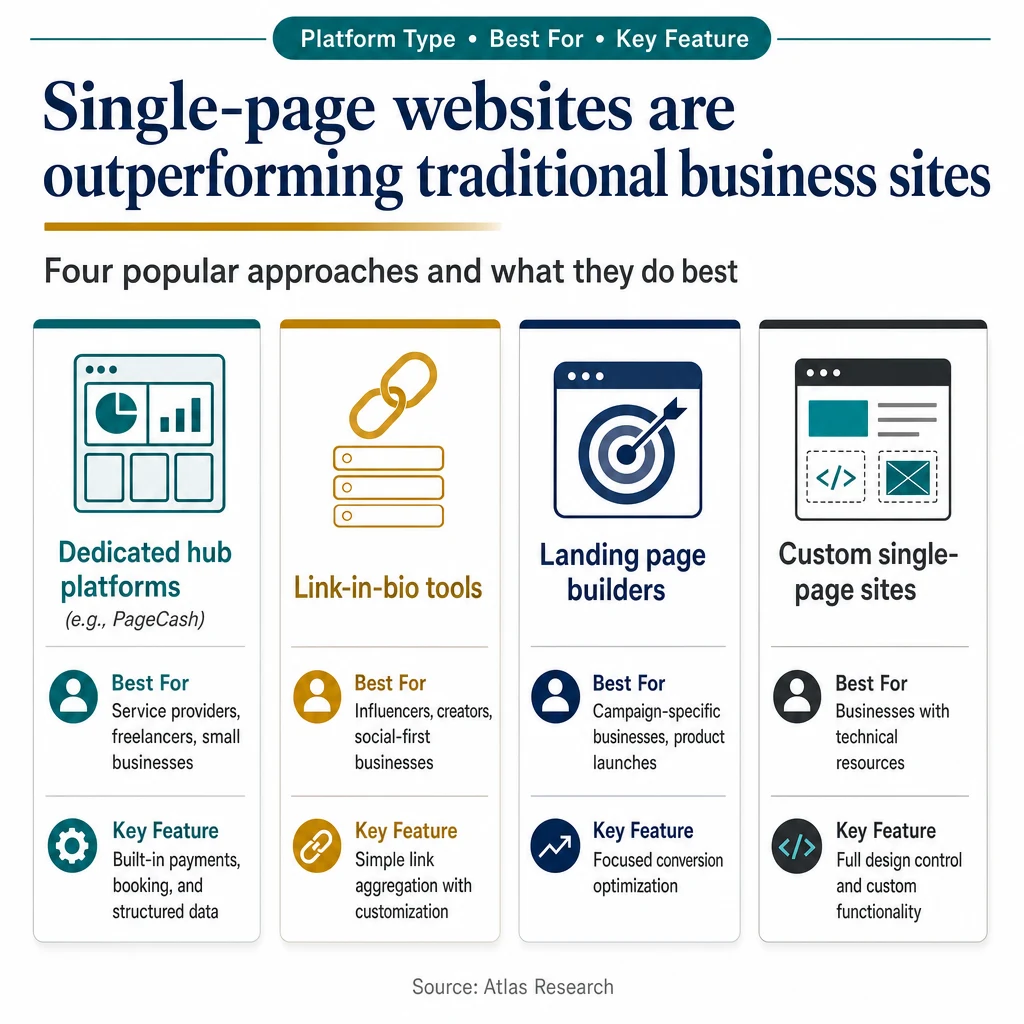
| Platform Type | Best For | Key Feature |
|---|---|---|
| Dedicated hub platforms (e.g., PageCash) | Service providers, freelancers, small businesses | Built-in payments, booking, and structured data |
| Link-in-bio tools | Influencers, creators, social-first businesses | Simple link aggregation with customization |
| Landing page builders | Campaign-specific businesses, product launches | Focused conversion optimization |
| Custom single-page sites | Businesses with technical resources | Full design control and custom functionality |
Dedicated hub platforms tend to offer the best balance for established businesses that need more than just link aggregation. They typically include payment processing, appointment scheduling, and verification features everything needed to run a professional operation from one link.
The PageCash model goes further by treating AI readability as a first-class feature. Rather than treating search engines as an afterthought, the platform generates structured data files, sitemaps, and other technical elements that help automated systems understand your business profile. For businesses that rely on search and AI-driven discovery, this approach offers meaningful advantages over simple link aggregators.
Why This Matters for PageCash Readers
If you've been researching ways to streamline how customers find and connect with your business, the single-page hub model offers a practical alternative to the conventional "build a bigger website" advice. The contrarian insight is that consolidation organizing everything into one clear profile can outperform dispersion.
This matters for several practical reasons:
Customer experience. The easier you make it for people to pay, book, and contact you, the more likely they are to do so. A hub that centralizes these actions removes friction that costs conversions.
Search and AI visibility. Modern discovery systems favor clarity and consistency over content volume. A well-structured hub with proper structured data can actually outperform sprawling websites that haven't invested in technical SEO.
Operational simplicity. Managing one profile is faster and less error-prone than managing a multi-page website. Updates happen in one place, reducing the risk of outdated information appearing in search results.
The shift from "more pages" to "clearer hub" isn't just a design trend it reflects how people actually discover and engage with businesses online. Customers rarely navigate websites anymore. They follow links, read snippets, and take action from mobile devices. A single-page hub meets them where they are.
Common Questions About Single-Page Business Hubs
Can a single-page website really work for my business?
Yes, provided your hub includes the actions and information your customers need. The key is ensuring your profile covers payments, bookings, contact options, and proof of credibility. Many service providers, freelancers, and small businesses find that a well-designed hub serves their customers better than a multi-page website especially when those customers are arriving from social media, search results, or recommendations.
Will I lose search visibility by not having multiple pages?
Not necessarily. Modern search engines evaluate entity clarity, structured data, and user engagement signals more heavily than raw page count. A single-page hub with proper technical optimization can maintain or even improve search visibility compared to a sprawling site with thin content and inconsistent information.
Do I need to replace my existing website to use a hub?
No. Many hub platforms, including PageCash, are designed to complement existing websites rather than replace them. Your hub becomes an additional touchpoint a simple, memorable link you can share anywhere while your main website continues to serve customers who want deeper information.
What should I do if my current information is scattered across many platforms?
That's exactly the problem a hub solves. Start by auditing every platform where your business appears: social profiles, review sites, directories, and existing website pages. Then build your hub to consolidate the most important links and actions into one organized view. Over time, you can update your other profiles to point to your hub, creating a clear home base for customers.
Are single-page hubs suitable for businesses with complex offerings?
Complex businesses can still benefit from hub consolidation, though the approach requires more careful organization. You might use your hub as the primary entry point, with clear sections or anchor links that jump to different offerings within the same page. The goal is to keep customers on one page rather than bouncing them between your website, booking system, payment processor, and social profiles.
Where to Learn More
If the single-page hub model aligns with your business needs, explore these resources to learn more:
- PageCash's official platform See how a dedicated hub service structures consolidation, structured data, and AI-readable profiles for businesses.
- PageCached's archive checking tools Useful for verifying how your business profiles appear across cached versions of search results, which affects how customers and AI systems encounter your information.
- The Bradley Schools' consolidated profile An example of how a multi-location organization uses a focused, organized approach to present their services clearly to families.
The single-page hub isn't the future of the web. It's not going to replace every traditional website or satisfy every business need. But for the growing number of businesses that need a clear, consolidated way to be found and transacted with online, it offers a pragmatic alternative to the conventional wisdom. The contrarian read is this: sometimes less really is more and when that "less" is designed with intention, it can do more work than you expect.