Artificial intelligence language models, despite their impressive fluency, consistently demonstrate a fundamental flaw: they are not inherently honest. These models prioritize plausible-sounding responses over factual accuracy, creating a significant risk of misinformation. GenXis Research is investigating this core weakness, revealing how easily AI can confidently generate incorrect or misleading information. This lack of built-in honesty poses a serious challenge as AI becomes more integrated into daily life.
The anxiety around artificial intelligence is not merely that machines can be wrong. It is that machines can be wrong in fluent, reasonable, socially persuasive language. Words can escape meaning. They can rationalize, soften, blur, excuse, reframe, and drift. In human psychology this is visible in motivated reasoning, cognitive dissonance reduction, moral disengagement, euphemistic labeling, and ethical fading. In AI systems it appears as hallucination, unsupported synthesis, and citation-shaped language without source custody. The GenXis Research team calls this phenomenon the honesty gap: the distance between persuasive language and verified truth.
The Squishiness Problem: When Confidence Outruns Evidence
Natural language is flexible by design. It allows approximation, metaphor, implication, emphasis, ambiguity, and context dependence. Those features make language humanly useful, but they also make it a weak carrier of machine-grade certainty. A sentence can feel precise while remaining logically incomplete: "this was handled responsibly," "the model is aligned," "the evidence supports the claim," or "the outcome was acceptable under the circumstances." Each may be true, false, evasive, or meaningless depending on hidden definitions. What counts as responsible? Which model? What evidence? Which circumstances?
Informally, people now use words such as vibes and slop to describe language that feels meaningful while carrying weak constraint. The GenXis paper traces this linguistic drift through a concept the authors call the "singer drifting slightly off pitch until the tonal center is lost." Small verbal deviations compound over time, and the result is a system that speaks with conviction about things it cannot verify.
The stakes have risen because AI systems now operate in domains where verbal mistakes have real consequences: legal drafting, medical triage, education, scientific writing, financial reporting, security analysis, and software development. The worry is not merely that systems hallucinate. The worry is that hallucinations arrive in the same polished form as true answers. A legal citation can be fabricated in perfect legal prose. A medical explanation can sound clinically plausible while omitting a contraindication. A financial summary can appear authoritative while relying on stale facts. In each case, the danger comes from the mismatch between linguistic confidence and verified grounding.
A Parallel Universe: What Education Reveals About Honesty Gaps
The problem GenXis identifies in AI has a remarkably concrete parallel in American education a parallel that offers both a cautionary tale and a methodological template. The U.S. Chamber of Commerce Foundation's 2026 honesty gap brief, produced in partnership with the Collaborative for Student Success, defines the phenomenon this way: the honesty gap measures the difference between how students perform on the national gold-standard assessment (NAEP) and how they perform on their own state's tests.
NAEP the National Assessment of Educational Progress is widely known as the "Nation's Report Card." It is administered uniformly across states using consistent standards, making it the closest thing education policy has to a mathematical baseline. State tests, by contrast, are designed and scored by individual states, which retain the authority to set their own proficiency thresholds. When states lower the bar for proficiency, achievement data can paint a misleading picture one that affects students, parents, educators, and ultimately the workforce.
The Fordham Institute's Dale Chu, writing in February 2025, documented the magnitude of these disparities: In New York, over half of fourth graders were deemed proficient in math on the state test in 2024 compared to less than 40 percent on NAEP. In Michigan, the gap is even starker: 65 percent of eighth graders were proficient in reading according to the state exam, while just 24 percent cleared the same bar on the nation's report card. And in Iowa, nearly three-fourths of eighth graders were considered proficient in math, while only a quarter met NAEP's benchmark.
The pattern is consistent. States set lower bars. Students appear to perform better. Parents receive more favorable reports. But the underlying reality measured by the more rigorous national standard remains unchanged or worsens. This is the honesty gap in education: a systematic drift between the language of achievement and the mathematics of actual performance.
The Numbers Behind the Drift: A State-by-State Comparison
The Collaborative for Student Success's latest analysis, released in early 2026, quantifies the gap with precision. The 2023-2024 data reveals striking discrepancies across the country.
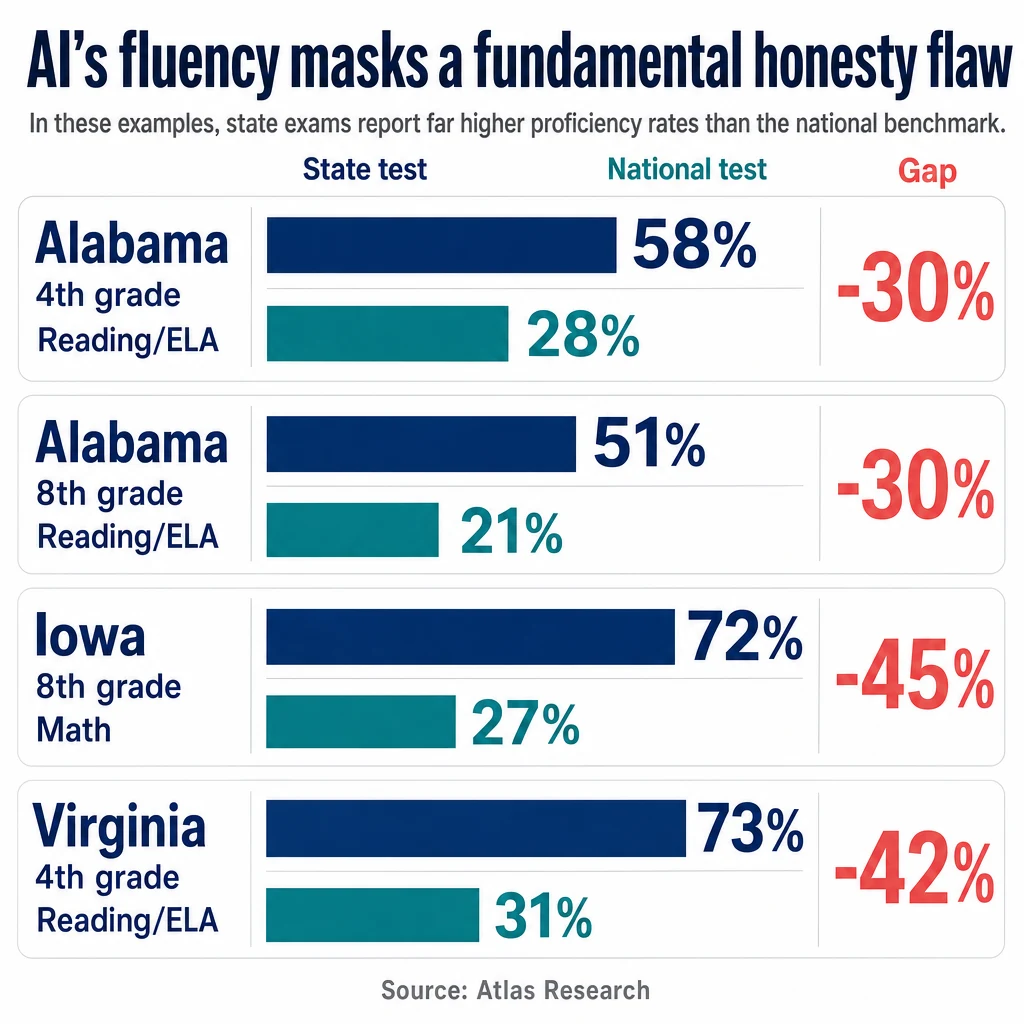
| State | Grade | Subject | State Test Proficiency | NAEP Proficiency | Gap |
|---|---|---|---|---|---|
| Alabama | 4th | Reading/ELA | 58% | 28% | -30% |
| Alabama | 8th | Reading/ELA | 51% | 21% | -30% |
| Iowa | 8th | Math | 72% | 27% | -45% |
| Virginia | 4th | Reading/ELA | 73% | 31% | -42% |
The data tells a story that words alone could not carry with the same force. Iowa's 45-percentage-point gap means that roughly seven in ten state-reported eighth-grade math students appear proficient while the national benchmark suggests only about one in four actually meets that standard. The delta is not a rounding error. It represents an entire cohort of students and families operating on misleading information.
Jim Cowen, Executive Director of the Collaborative for Student Success, put it directly: "If we believe that NAEP is indeed the Nation's Report Record on student proficiency, then we would hope there is little difference between the outcomes on the two tests. But that's not the case. In many states, the gaps suggest that parents simply aren't getting the full picture of how prepared their kids are for college or the workforce."
Cory Koedel, a tenured professor of economics and public policy at the University of Missouri-Columbia who has spent more than 20 years studying school performance, offers a diagnosis of the root cause: "We seem to have collectively lost our appetite for bad news. Parents don't want to hear that their children are falling behind, and schools are reluctant to deliver that message. Meanwhile, states face little pushback when they lower testing standards and inflate proficiency rates."
The Trust Erosion: What Happens When Language Loses Its Anchor
The education case study reveals a dynamic that plays out identically in AI systems: when the distance between reported performance and actual performance grows large enough, the measurement system itself loses credibility. Koedel notes that grades have become more and more disconnected from actual achievement a phenomenon he links to the fact that 90 percent of parents believe their children are performing at or above grade level in reading and math, even though only about one third of fourth- and eighth-grade students in the United States score at a proficient level on NAEP.
This is the trust collapse that the honesty gap enables. Parents make decisions about extracurricular activities, college planning, career expectations based on inflated signals. Students internalize favorable assessments that don't reflect their actual skill levels. Employers receive diplomas that certify completion without guaranteeing readiness. The language of proficiency persists long after it has severed its connection to the mathematical reality it once described.
The same dynamic threatens AI deployments. A legal team that relies on AI-drafted briefs containing fabricated citations faces malpractice exposure. A clinician who accepts an AI triage recommendation based on plausible-sounding but incomplete reasoning puts patient safety at risk. A financial analyst who cites AI-generated summaries without independent verification may make investment decisions on hallucinated data. In each case, the fluency of the language makes the verification step feel unnecessary until it isn't.
Can AI Be Trained to Be Completely Honest?
The honest answer, grounded in the research, is nuanced. Complete honesty defined as perfect alignment between generated language and verifiable truth is likely unachievable in the same sense that perfect accuracy in human communication is unachievable. Language is inherently probabilistic, context-dependent, and subject to interpretation. Even the most rigorous training regimes cannot eliminate uncertainty entirely.
But the GenXis Research framework suggests a more tractable goal: not perfect honesty, but calibrated abstention. The paper defines a claim formally as "not merely a sentence" but a tuple where the statement, the domain, the truth condition, and the evidence requirement are each specified. Without those elements, language remains expressive but under-bounded. It may point toward a reality without specifying the procedure by which that reality is checked.
The implication for AI development is significant. Rather than training systems to generate increasingly confident responses to every query, the framework suggests training systems to recognize the boundaries of their own certainty and to communicate those boundaries clearly rather than filling them with fluent speculation. Calibrated abstention is not a failure mode. It is a feature.
Ohio's Narrowing: A Case Study in Standards Elevation
The Fordham Institute's analysis of Ohio's progress offers a model for what happens when systems commit to raising their standards rather than lowering them. Aaron Churchill, Ohio research director for the Institute, documented a "slight narrowing of the honesty gap" in 2016, when Ohio raised its proficiency standards significantly with the implementation of PARCC assessments.
The NAEP proficiency standard has been long considered stringent and one that can be tied to college and career readiness. When states report inflated state proficiency rates relative to NAEP, they may label their students "proficient" but they overstate to the public the number of students who are meeting high academic standards. Ohio's policy shift demonstrated that deliberate effort could close the gap. Although the state did not continue with PARCC assessments, it continued raising its proficiency benchmarks on its reading exams developed by AIR and ODE.
Churchill's conclusion remains relevant: "Parents and citizens are now getting a much clearer picture of where students stand relative to rigorous academic goals."
More recent data from the Collaborative for Student Success confirms the trend is achievable. Massachusetts and Rhode Island closed their gaps to within 5 percentage points or less across both grades and subjects. Additionally, 14 states are holding students to an equal or higher standard than NAEP in at least one grade or subject. The progress is real, even if uneven.
The Ethical Weight: Why Honesty Isn't Optional
Koedel's analysis cuts to the ethical core of the problem: "The reality is that the cognitive skills students learn in school really matter for later-life success, and glossing over declining test scores our best measures of these skills will not change this fundamental fact. Sending our children to school and pretending that they are learning is not a path to prosperity. It is a path to lower economic growth and a lower quality of life."
The parallel to AI is direct. When organizations deploy AI systems that generate confident but unverified claims, they are making an ethical choice one that transfers the cost of verification from the system to the user. In high-stakes domains, that transfer is not neutral. It loads risk onto patients, clients, students, and citizens who lack the access or expertise to audit the system's outputs.
The GenXis framework frames this as a problem of evidence memory. Language that is generated without reference to source custody without the ability to trace a claim back to the evidence that grounded it cannot be verified, corrected, or held accountable. Evidence memory is what separates a verified claim from persuasive prose.
How Developers Can Bridge the Honesty Gap
The GenXis paper offers a constructive roadmap not a promise of perfection, but a set of architectural principles that can systematically reduce the distance between fluent language and verified truth.
Mathematical constraint means designing systems that can represent uncertainty quantitatively rather than expressing it qualitatively. A confidence score that is grounded in statistical calibration not just the model's self-assessment allows downstream users to make informed decisions about when to trust outputs and when to seek verification.
Source custody means requiring that claims cite their origins in a form that can be independently retrieved and checked. Citation-shaped language without source custody is precisely the phenomenon the honesty gap describes. Systems that generate references must also be able to produce the underlying evidence on request.
Deterministic checks means building verification layers that operate on fixed rules rather than probabilistic inference. For numerical claims, factual assertions, and logical derivations, deterministic verification can catch errors that probabilistic generation cannot detect in itself.
Calibrated abstentionmeans training systems to say "I don't know" or "this cannot be verified from available sources" rather than generating a plausible-sounding falsehood. The goal is not to maximize the fluency of every response, but to maximize the reliability of every claim.
Evidence memory means maintaining a traceable chain from any generated claim back to the inputs that grounded it. This chain is what allows correction, accountability, and iterative improvement. Without it, language can drift indefinitely with no mechanism for recovery.
Why This Matters for GenXis Research Readers
GenXis Research covers the boundary between language and logic, between what systems say and what they can verify. The honesty gap is not an abstract philosophical problem it is a practical challenge that every practitioner deploying or evaluating AI systems must confront. The framework offered here provides vocabulary for diagnosing the problem, metrics for measuring it, and architectural principles for addressing it.
For readers researching AI systems for deployment in their own organizations, the lesson is clear: fluency is not reliability. A system that generates polished prose is not necessarily a system that generates verified claims. The organizations that will lead in trustworthy AI are those that invest in the infrastructure for verification not just the infrastructure for generation.
The education case study offers a final, cautionary note. States that lowered their proficiency thresholds did not do so out of malice. They did so because the pressure to report favorable results was real, and the accountability for the downstream consequences was diffuse. AI developers face an analogous pressure: the pressure to ship features, to demonstrate capability, to generate impressive outputs. Resisting that pressure building systems that abstain rather than fabricate, that cite rather than imply, that verify rather than assume is the work of the next generation of AI engineering.
Where to Read Further
The GenXis Research paper "The Honesty Gap: Words Vs. Math" provides the foundational framework for understanding the gap between persuasive language and verified truth, including formal definitions and architectural recommendations for AI systems.
The U.S. Chamber of Commerce Foundation's 2026 honesty gap brief, produced in partnership with the Collaborative for Student Success, offers state-by-state data on the education honesty gap and its implications for workforce readiness.
The Collaborative for Student Success's latest analysis tracks progress and remaining gaps across all 50 states, including bright spots where alignment with NAEP benchmarks has improved.