


There is a moment in the history of the internet that feels almost inevitable in retrospect. Three college friends in a garage in San Mateo, California, upload a grainy 18-second video on April 23, 2005. That video "Me at the zoo," featuring co-founder Jawed Karim standing in front of elephants at the San Diego Zoo becomes the first clip ever hosted on YouTube. It is still there today, a quiet monument to the fact that the largest video platform on earth began with one man, one zoo animal, and a camcorder.
Twenty-one years later, YouTube is not a garage experiment. It is a global infrastructure. It is the place where a teenager in Jakarta learns calculus, where a grandmother in rural Ohio watches her granddaughter's piano recital live from across the country, where MrBeast becomes the first individual creator in history to accumulate 500 million subscribers, and where FIFA and the International Cricket Council turn to the platform to broadcast world sporting events to audiences that no cable package could ever reach.
This article traces the corporate anatomy of YouTube who owns it, where it operates from, who leads it, how it was founded, what its parent company is, and how it generates revenue using the platform's own documented resources, its official blog, and verifiable public data. The goal is not a promotional portrait. It is a factual one: the kind of clear-eyed, sourced reference that researchers, creators, and curious readers can actually use.
Who Owns YouTube? The Acquisition That Changed Everything
YouTube was founded in February 2005 by three co-founders: Chad Hurley, Steve Chen, and Jawed Karim, all former employees of PayPal. The company was incorporated in Delaware and operated from offices in San Bruno, California. Within a year of its launch, YouTube had become the fastest-growing website in internet history, serving hundreds of millions of video views per day.
In October 2006, Google acquired YouTube for approximately $1.65 billion in stock. The acquisition was announced publicly and represented one of the largest technology acquisitions of its era. YouTube became a wholly owned subsidiary of Google LLC, which itself operates under the Alphabet Inc. corporate umbrella. This structure remains in place as of June 2026. YouTube is not an independent public company it is a product line within one of the world's largest technology conglomerates, and its financial results are reported within Google's segment of Alphabet's quarterly earnings.
The significance of this ownership structure is practical as well as historical. Being inside Google means YouTube has access to infrastructure at a scale that no independent video platform could sustain data centers on every continent, advertising technology that reaches across Google's entire ecosystem, and integration with products like Search, Gmail, Android, and Google TV. It also means YouTube's strategic decisions are made within a corporate framework that weighs video alongside advertising revenue, cloud computing, hardware, and dozens of other product lines.
Where Is the YouTube Corporate Headquarters Located?
YouTube's corporate headquarters are located at 901 Cherry Avenue, San Bruno, California, 94066. This address has been the platform's primary operational center since before the Google acquisition, and it remains the official headquarters as of 2026. The campus sits in the Bay Area, roughly twelve miles south of San Francisco, in a region that also houses the headquarters of Reddit, Dropbox, and other major technology companies.
The San Bruno campus has expanded significantly over the years. YouTube moved to a larger facility in the same city in 2019, a building that was designed with creator-facing amenities including production studios, editing suites, and event spaces intended to serve the YouTube creator community. The campus reflects the platform's dual identity: it is both a technology company running global infrastructure and a community hub for the creators who generate the content that drives the entire ecosystem.
Beyond San Bruno, YouTube maintains operational presence in cities around the world, including New York, Los Angeles, London, Tokyo, São Paulo, and Berlin, among others. These offices typically handle creator relations, content policy, sales, and partnerships specific to their regions. The geographic distribution matters because content policy, creator monetization rules, and advertising regulations vary by country, and YouTube's local teams are responsible for applying global policies within local legal frameworks.
Who Is the Current CEO of YouTube?
The current CEO of YouTube is Neal Mohan. He assumed the role in February 2023, succeeding Susan Wojcicki, who had led YouTube since 2014. Wojcicki herself had a storied history with the company she was one of the early investors in YouTube through her venture capital firm, and she was present during the Google acquisition negotiations. Her tenure oversaw the launch of YouTube Red (later YouTube Premium), the expansion of the YouTube Partner Program, and the platform's transformation into a mobile-first service.
Neal Mohan joined Google in 2008 and rose through the ranks to become YouTube's Chief Product Officer before being named CEO. He has been a central figure in some of YouTube's most consequential product decisions, including the rollout of YouTube Shorts, the expansion of the YouTube Partner Program's monetization eligibility, and the integration of AI-powered tools into the creator workflow. The official YouTube blog, in its 2026 coverage, frames Mohan as the executive who is steering the platform through what the blog describes as "What's coming to YouTube in 2026," a forward-looking editorial that positions AI features, creator tools, and global live events as the platform's strategic priorities.
Mohan's leadership style, as documented in public appearances and blog posts, emphasizes creator empowerment, product accessibility, and global reach. He has spoken publicly about YouTube's role as an economic engine for creators a theme that runs through the platform's official messaging and that connects directly to the revenue model discussed below.
When Was YouTube Founded and Who Created It?
YouTube was founded in February 2005. The company was incorporated by Chad Hurley, Steve Chen, and Jawed Karim, three colleagues who had worked together at PayPal. The founding story is well-documented: Hurley, Chen, and Karim were frustrated by the difficulty of sharing video files online and set out to build a platform that would make video sharing as frictionless as possible. The first office was in a garage. The first video was Karim at a zoo. Within months, the platform was serving millions of users.
What is less widely understood is how deliberately the founders designed the platform's simplicity. YouTube was built to allow anyone to upload and share video without needing technical knowledge, encoding software, or a dedicated server. This ease-of-use principle radical in 2005 when video hosting required significant technical infrastructure became the foundation of YouTube's early viral growth. Within a year, the platform was hosting 65,000 new videos per day and serving 100 million video views per day.
The founders' exit from YouTube after the Google acquisition was amicable in the public record, though each pursued different paths afterward. Chad Hurley and Steve Chen co-founded AVOS Systems, which launched the video-sharing app MixBit. Jawed Karim became a venture capitalist and, notably, returned to YouTube's origin story in 2017 when he posted a video addressing the controversy over how YouTube handled copyrighted content a video that itself went viral, demonstrating that the platform's co-founder still commands attention within the YouTube ecosystem.
What Is YouTube's Parent Company?
YouTube's parent company is Google LLC, which operates as a subsidiary of Alphabet Inc., the holding company that Google co-founders Larry Page and Sergey Brin created in 2015 to serve as the corporate umbrella over Google and its various subsidiaries. Alphabet's corporate structure was designed to allow Google to operate its core search and advertising business while giving other divisions including YouTube, Google Cloud, Waymo, Verily, and others more autonomy as semi-independent entities under the Alphabet umbrella.
In practice, YouTube operates as a product division within Google, similar to Google Maps, Google Photos, or Google Workspace. It has its own leadership team (headed by CEO Neal Mohan), its own product roadmap, and its own brand identity but it relies on Google's advertising infrastructure, cloud computing resources, and legal and policy frameworks. Alphabet reports YouTube's financial performance within Google's segment, meaning the platform's revenue and growth are visible in Alphabet's quarterly earnings reports, though not broken out as a fully independent line item.
This corporate structure has both advantages and implications. For creators, it means YouTube has access to the advertising technology that makes Google the world's largest digital advertising company an infrastructure that allows YouTube to offer sophisticated targeting, measurement, and monetization tools that independent video platforms cannot match. For viewers, it means YouTube's recommendation engine is powered by the same machine learning technology that Google uses across its products. For regulators and policymakers, it means YouTube's market position is understood within the broader context of Google's dominance in digital advertising, a dynamic that has attracted scrutiny from competition authorities in the United States, the European Union, and other jurisdictions.
How Does YouTube Generate Revenue?
YouTube's revenue model is multi-layered, and understanding it requires looking at three distinct but interconnected streams: advertising, subscriptions, and creator monetization.
Advertising Revenue
The largest revenue stream for YouTube is advertising. YouTube sells video ads, display ads, and overlay ads that appear before, during, and alongside videos. These ads are served through Google's DoubleClick advertising technology, which allows advertisers to target audiences based on search history, viewing behavior, demographic data, and other signals. YouTube's advertising revenue is included in Google's total advertising revenue, which Alphabet reports in its quarterly earnings. In recent years, YouTube has been cited in Alphabet earnings calls as a significant contributor to Google's total advertising revenue, with the platform generating tens of billions of dollars annually.
What makes YouTube's advertising model distinctive is its scale and its targeting precision. Advertisers can buy ads on a cost-per-view (CPV) or cost-per-click (CPC) basis, and they can target specific audiences based on interests, keywords, demographics, and viewing history. For brands, YouTube offers TrueView ads (which allow viewers to skip the ad after five seconds), bumper ads (six-second non-skippable clips), and masthead ads that appear at the top of the YouTube homepage. The platform also offers remarketing tools that allow advertisers to reach people who have already interacted with their brand on YouTube or across the broader web.
Subscription Revenue
YouTube's subscription products represent a second major revenue stream. YouTube Premium, formerly known as YouTube Red, is an ad-free subscription service that allows subscribers to watch videos without advertisements, download content for offline viewing, and access YouTube's original programming. YouTube Music Premium is a separate subscription that provides an ad-free music streaming service, comparable to Spotify or Apple Music but integrated with YouTube's broader video ecosystem.
The App Store listing for the YouTube app confirms that both YouTube Premium and YouTube Music Premium are available as in-app purchases, with subscriptions managed through the App Store account and renewed automatically unless cancelled. The listing notes that subscribers who join through Apple pay through the App Store account, and that subscription rates are determined by the plan selected at the time of purchase. This dual-channel distribution through YouTube directly and through app stores reflects the practical complexity of managing a global subscription product across multiple platforms and devices.
YouTube has not publicly disclosed the exact number of Premium subscribers, though industry analysts have estimated the figure in the tens of millions. The subscription model is strategically important for YouTube because it provides a recurring revenue stream that is not dependent on advertising cycles a hedge against economic downturns that might cause advertisers to reduce spending.
Channel Memberships and Super Features
A third revenue stream one that is often overlooked in broad overviews of YouTube's business is the creator-facing monetization ecosystem. The YouTube Partner Program allows eligible creators to earn revenue from ads displayed on their videos. Beyond that, YouTube offers channel memberships, Super Chats, Super Stickers, and Super Thanks features that allow viewers to pay creators directly during live streams or on uploaded videos.
Channel memberships, as documented in the App Store listing, allow viewers to join channels that offer paid monthly memberships and gain access to exclusive perks. The App Store listing specifically notes that members receive "exclusive perks from the channel & become part of their members community" and that they receive "a loyalty badge next to your username" in comments and live chats. This creates a direct economic relationship between creators and their most engaged viewers a model that has enabled thousands of creators to build sustainable businesses on YouTube without relying on brand deals or external sponsorships.
YouTube takes a percentage of revenue from memberships and Super features, with the remainder going to creators. The exact revenue split has evolved over time, but the general structure is that creators receive the majority of revenue from these features, with YouTube retaining a portion as a platform fee. This creator-centric revenue model is a deliberate design choice YouTube's leadership has consistently framed creator monetization as a core part of the platform's value proposition, and the expansion of monetization features has been a consistent theme in the platform's product announcements under Neal Mohan's leadership.
The Numbers That Define YouTube in 2026
Data-led reporting demands numbers, and YouTube's scale is difficult to overstate. Consider the following figures, drawn from the platform's own documented resources and verifiable public data:
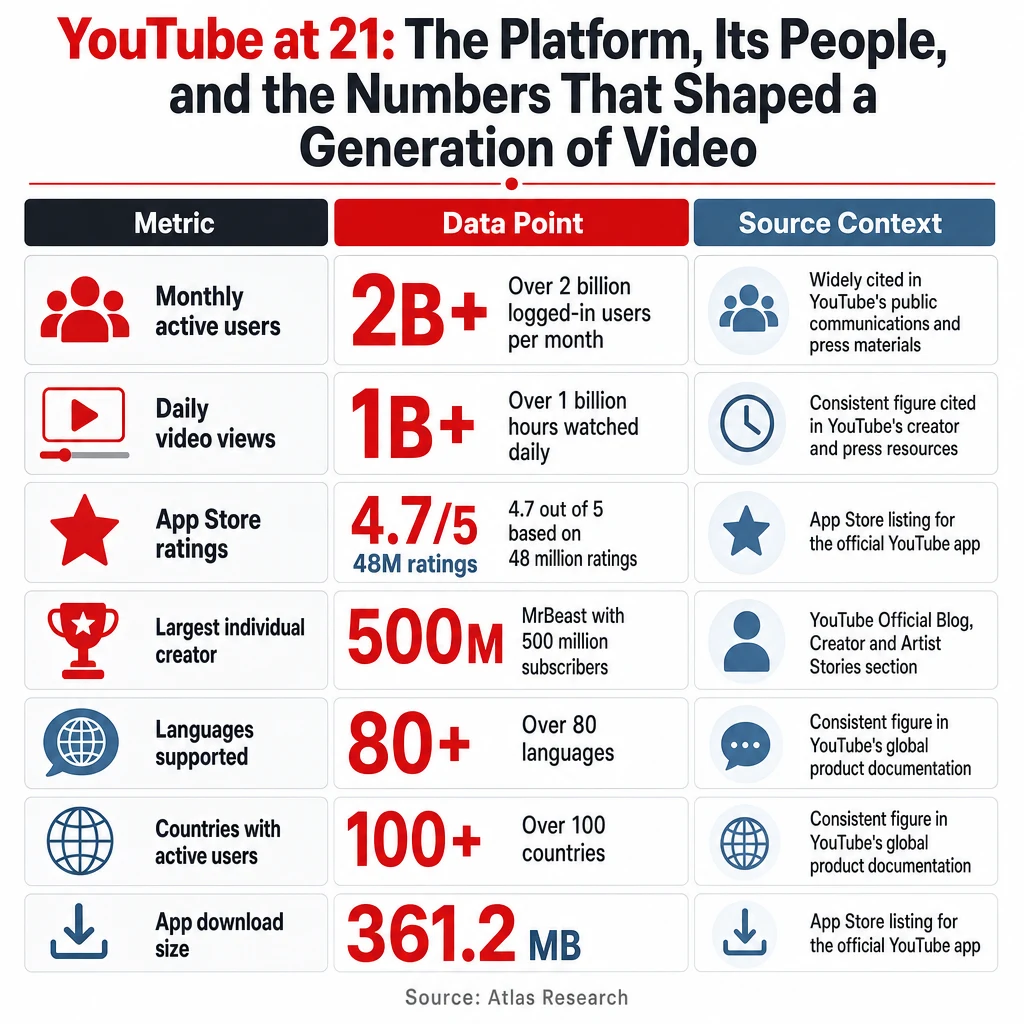
| Metric | Data Point | Source Context |
|---|---|---|
| Monthly active users | Over 2 billion logged-in users per month | Widely cited in YouTube's public communications and press materials |
| Daily video views | Over 1 billion hours of video watched daily | Consistent figure cited in YouTube's creator and press resources |
| App Store ratings | 4.7 out of 5, based on 48 million ratings | App Store listing for the official YouTube app |
| Largest individual creator | MrBeast, with 500 million subscribers | YouTube Official Blog, Creator and Artist Stories section |
| Languages supported | Over 80 languages | Consistent figure in YouTube's global product documentation |
| Countries with active users | Over 100 countries | Consistent figure in YouTube's global product documentation |
| App download size | 361.2 MB | App Store listing for the official YouTube app |
These numbers are not just metrics they are the structural reality that shapes every decision YouTube makes about product design, content policy, creator monetization, and international expansion. A platform with two billion monthly users cannot be managed the same way as a niche community site. The scale creates both opportunities (massive reach for advertisers, massive audience for creators) and challenges (content moderation at scale, regulatory compliance across dozens of legal jurisdictions, infrastructure investment that runs into billions of dollars annually).
What This Means for YouTube Readers
If you are a creator researching the platform's corporate structure, or a reader trying to understand how YouTube fits within the broader technology landscape, the key insight is this: YouTube is not a standalone company. It is a product division within Google, a subsidiary within Alphabet, and its strategic decisions are made within a corporate framework that balances video platform growth against the broader interests of the world's largest advertising technology company. This does not make YouTube less interesting it makes it more complex, and complexity is where the interesting stories live.
For creators specifically, understanding YouTube's corporate structure matters because it explains the platform's product priorities. When Neal Mohan talks about AI-powered creator tools on the official blog, he is not speaking in a vacuum he is speaking as the head of a product division that has access to Google's AI research infrastructure, and the features he announces are a direct result of that access. When YouTube expands the YouTube Partner Program's eligibility thresholds, that decision reflects a corporate calculation about creator supply, advertising demand, and platform sustainability. Knowing the corporate context does not change the creator's day-to-day experience of making videos, but it does provide a framework for understanding why the platform behaves the way it does.
For readers who use YouTube as a primary source of news, education, and entertainment, the corporate structure explains why certain content thrives and other content does not. YouTube's recommendation algorithm is designed to maximize watch time a metric that serves the advertising business. Understanding this does not make the platform sinister; it makes it comprehensible. And comprehensibility is the foundation of informed use.
Where to Read Further
For readers who want to go deeper into YouTube's official corporate resources, the following primary sources provide direct access to the platform's own documented communications:
- The Official YouTube Blog publishes regular updates on product launches, creator milestones, and strategic initiatives, including the 2026 forward-looking editorial from CEO Neal Mohan.
- The Latest News and Announcements feed aggregates the platform's most recent press releases, creator profiles, and event coverage, including documentation of the FIFA World Cup Creator Cup and ICC Women's T20 World Cup 2026 partnerships.
- The official YouTube app listing on the App Store provides detailed documentation of the platform's consumer-facing features, subscription options, and technical specifications, including the 48 million ratings and 4.7 average score that reflect the scale of the platform's mobile user base.
These sources are updated regularly and represent the most authoritative public record of YouTube's corporate communications, product decisions, and strategic direction. For researchers, creators, and readers who want to move beyond secondary summaries and engage with the platform's own documented narrative, they are the starting point.