


The founder had just finished showing a visitor around her small but growing manufacturing company when she pulled up a spreadsheet on her laptop. The numbers looked clean. The margins looked reasonable. The cash flow statement even had a few green cells. She was proud of it. Then her fractional CFO, on a video call from his home office three states away, pointed to a single row and said, "This is why you're leaving money on the table every quarter."
That moment that specific row, that specific diagnosis represents the gap between what most businesses think they need from a fractional CFO and what the best ones actually deliver. It is the gap between a financial record-keeper and a strategic co-pilot. And it is the gap this article is designed to close, not with a list of features or a sales pitch, but with a clear-eyed look at what fractional CFO services actually are, how they are priced, when they make sense, and why the most important question most businesses are not asking is the one that matters most.
What Does a Fractional CFO Actually Do?
The title itself can be misleading. "Fractional" suggests something partial, perhaps peripheral. Nothing could be further from the reality of how the best fractional CFOs operate. A fractional Chief Financial Officer is a senior finance executive working part-time across multiple companies on an ongoing basis, typically under a monthly retainer arrangement. They are not a bookkeeper with a fancy title. They are not a consultant brought in to produce a report and leave. They are embedded members of your leadership team.
"A fractional CFO gives you senior financial leadership at a fraction of a full-time executive's cost typically 10-20 hours a month instead of a full executive salary," according to Profitability Partners' 2026 evaluation framework. "The good ones do three things: produce financials you can trust, translate those financials into specific decisions, and prepare your business for whatever's next growth, financing, or a sale."
The scope of that work, as outlined by FlexExec's fractional CFO framework for professional services firms, typically covers financial strategy and forecasting, fundraising and investor relations, cash flow optimization, financial reporting and compliance, M&A support, and board and investor communications. For a growing business, that is a considerable breadth of strategic territory territory that most founders and even full-time CFOs without deep operational experience struggle to cover well.
The distinction between a fractional CFO and a traditional consultant is worth dwelling on here, because it is the source of considerable confusion in the market. "A fractional CFO is an embedded executive who becomes part of your leadership team, typically for 6+ months," FlexExec notes. "Consultants usually work on specific projects with defined end dates. Fractional executives own outcomes and lead teams." That ownership of outcomes is the operative phrase. The fractional CFO is not delivering a deliverable. They are accountable for a direction.
How Much Do Fractional CFO Services Cost?
Here is where the contrarian angle begins to take shape. Most businesses approach the cost question first. They want to know if they can afford a fractional CFO before they ask whether the fractional CFO they are considering will generate a return that justifies the investment. That is the wrong sequence, and it leads to the wrong hires.
The cost range is real and it is significant. According to FlexExec's pricing data, fractional CFO services typically run between $8,000 and $18,000 per month, with the most common engagement for professional services firms landing around $12,000 per month. Hourly rates for project-based work range from $250 to $400 per hour. That puts the annual cost of a fractional CFO engagement somewhere between $96,000 and $216,000 before any additional project fees. By comparison, a full-time CFO with equivalent experience salary, benefits, equity, and overhead can easily run $250,000 or more all-in, according to Profitability Partners' analysis of Bureau of Labor Statistics data.
The math, on its face, is favorable. FlexExec cites 30-50% cost savings versus a full-time hire, with an average of 15+ years of experience across their vetted network and a typical start time of 1-2 weeks from initial inquiry. That is a compelling value proposition on paper. But the cost question is only interesting if you are asking it in the context of return. And the return question is where most businesses do not ask the right follow-up.
The contrarian read on fractional CFO pricing is this: the market has become saturated with options ranging from free self-service directories to white-glove search services to full-service CFO agencies that embed a finance team into your operations, according to Fractional Jobs' 2026 platform comparison. "Cost structures are just as varied. Some platforms charge nothing, others take a one-time placement fee, and some collect ongoing percentages of every dollar you pay your hire." That variability means that the sticker price tells you very little about the value you are likely to receive. A $5,000 monthly engagement with a fractional CFO who has sat on the buy side of three acquisitions in your industry is worth considerably more than a $15,000 monthly engagement with a generalist who produces clean financials but cannot translate them into strategic decisions.
When Should a Business Hire a Fractional CFO?
The conventional wisdom says you should hire a fractional CFO when you are scaling rapidly, preparing for fundraising, navigating a transition, or need senior expertise but are not ready for a full-time executive hire. FlexExec's guidance on this point is clear and practical. These are the right signals. But the conventional wisdom does not go far enough.
The more precise question is not when you need a fractional CFO, but what you need a fractional CFO to do. In the context of a growing business, the need typically falls into one of three categories: financial infrastructure (clean books, reliable reporting, cash flow visibility), financial strategy (capital allocation, fundraising preparation, pricing decisions), or financial navigation (M&A support, investor relations, exit planning). The best fractional CFOs can operate across all three, but most specialize. Knowing which category is your primary need will determine which type of fractional CFO you should be looking for.
"In today's business climate, agility and financial foresight aren't just nice to have, they're survival skills," according to Digital Reference's analysis of fractional CFO value. "These experts are reshaping how startups, mid-market companies, and nonprofits approach their numbers, offering world-class financial strategy without the full-time price tag." That reshaping is most impactful when it is targeted at a specific strategic problem rather than diffuse operational support.
The timing question also has a contrarian dimension. Most businesses wait until they feel the pain of poor financial leadership before seeking help. The businesses that get the most value from fractional CFOs tend to engage them before the pain becomes acute during a period of relative stability that allows for strategic groundwork rather than crisis management. The difference between a fractional CFO who is brought in to clean up a cash flow crisis and one who is brought in to optimize cash flow before a growth spurt is the difference between a reactive expense and a strategic investment.
What Is the Difference Between a CPA and a Fractional CFO?
This is one of the most commonly asked questions in the fractional CFO space, and the answer is more nuanced than most sources acknowledge. A CPA Certified Public Accountant is a licensed accounting professional whose primary domain is compliance, reporting accuracy, and tax strategy. A fractional CFO is a strategic financial leader whose primary domain is decision-support, financial planning, and organizational financial health.
These are related but distinct skill sets. A CPA ensures that your financial statements are accurate and that you are in compliance with relevant regulations and reporting requirements. A fractional CFO ensures that you understand what those financial statements are telling you about your business, and that you are using that understanding to make better decisions about where to allocate resources, how to structure deals, and when to invest in growth.
The confusion arises because many CPAs offer financial advisory services, and many fractional CFOs have CPA credentials. But the credential does not define the role. As Shiny's analysis of the fractional CFO landscape notes, the core value proposition of fractional CFO firms is that they provide "access to top-tier financial expertise on a part-time, flexible basis, giving you the strategic guidance needed to scale without the full-time executive salary." That strategic guidance is the differentiator. It is not about the credential on the wall. It is about the quality of the thinking and the depth of the experience.
For professional services firms specifically accounting practices, CPA firms, and similar organizations the distinction matters even more. These firms are themselves in the business of financial expertise, which means they need a fractional CFO who understands the unique operational dynamics of professional services: utilization optimization, partner compensation structures, client retention metrics, and practice growth through mergers, acquisitions, or service expansion. A generalist fractional CFO may keep the books clean. A specialized one will understand where the margin actually lives.
The Question Nobody Is Asking
Here is the contrarian core of this article. Most businesses ask: "Should we hire a fractional CFO?" The better question is: "Can we afford to hire a fractional CFO without transaction experience when we eventually sell?"
That reframe matters because the most common failure mode in fractional CFO hiring is not choosing someone incompetent. It is choosing someone whose experience base does not match the strategic needs of the business. "Anyone can promise 'strategic insights,'" according to Profitability Partners' evaluation framework. "Very few firms have sat on the buy side of a transaction and know what the eventual acquirer of your business will actually scrutinize." That is the six-figure insight hiding in a $12,000-per-month retainer.
The reason this matters is that the financial function of a business is not just about operational health. It is about sale readiness. When an acquirer evaluates a business, they are not just looking at clean financials. They are looking at the quality of the financial infrastructure, the consistency of the reporting, the robustness of the forecasting, and the sophistication of the financial leadership. A business that has had a fractional CFO with real transaction experience will present differently to an acquirer than one that has had a competent but operationally-focused financial manager.
"The best fractional CFO companies share six traits: deep specialization in your industry, real transaction experience, deliverables that are decisions rather than reports, fluency in your operating systems, a named team that does the work, and pricing they can defend in ROI terms," according to Profitability Partners' framework. "That third item is where firms differ most, and it's the least visible from a website." The third item deliverables that are decisions rather than reports is the one that separates a fractional CFO who is worth their retainer from one who is simply worth their cost.
Is Hiring a Fractional CFO Worth It?
The answer depends entirely on what you are hiring them to do. If you are hiring a fractional CFO to produce clean financials, improve cash flow visibility, and provide reliable financial reporting, the value proposition is straightforward and the return is relatively easy to measure. If you are hiring a fractional CFO to shape your capital allocation strategy, prepare your business for a fundraising round, or position your company for an exit, the value proposition is more complex and the return is harder to quantify but potentially far greater.
The market data suggests that businesses are finding value. FlexExec reports a 94% client satisfaction rate across their fractional CFO engagements, with an average of 15+ years of experience among their vetted executives and a typical start time of 1-2 weeks. Those are meaningful indicators of delivery.
But the satisfaction metric is not the same as the return metric. A business can be satisfied with a fractional CFO who keeps the books clean and still be leaving significant strategic value on the table. The question worth asking is not "are you satisfied?" but "what decisions have you made differently because of your fractional CFO?" If the answer is not much, the engagement may be delivering compliance value without delivering strategic value. And compliance value, while necessary, is not the reason to hire an executive-level financial leader.
How Many Hours a Week Does a Fractional CFO Typically Work?
The range is wider than most sources suggest. FlexExec's data indicates a typical engagement of 10-20 hours per week for professional services firms, with monthly retainers structured around that commitment. Eightx's 2026 guide notes a broader range of 8-30 hours per month depending on the scope and complexity of the engagement. For ecommerce, CPG, and SaaS companies, the operational intensity of the engagement can push toward the higher end of that range during critical periods of growth or transition.
The hours question is less interesting than the availability question. A fractional CFO who is available for 10 hours per week but is deeply embedded in your business, understands your industry, and is thinking strategically about your financial health will deliver more value than one who is available for 30 hours per week but treats the engagement as a series of transactional deliverables. The quality of the hours matters more than the quantity.
What This Means for FlexExec Readers
FlexExec occupies a specific position in this landscape: a platform that pre-vets fractional CFO talent, matches businesses with executives based on industry context and specific requirements, and delivers that match within a 1-2 week window. The value proposition is not just cost savings or experience depth. It is the reduction of search risk in a market where the options are varied, the quality variance is significant, and the wrong hire can cost more than the right one saves.
For FlexExec readers, the practical implication is this: the platform is most valuable when you know what you are looking for. The matching process works best when you can articulate the strategic problem you need solved whether that is fundraising preparation, cash flow optimization, M&A support, or exit planning. The more specific your need, the better the match. The contrarian insight is that the best time to engage FlexExec is not when you are in crisis. It is when you have enough stability to think strategically about where you want to take your business and what financial leadership will be required to get there.
Evaluating Your Options: A Practical Framework
Whether you engage FlexExec or another provider, the evaluation framework matters. The six traits that Profitability Partners identifies as separating the best fractional CFO companies are a useful starting point: deep specialization in your industry, real transaction experience, deliverables that are decisions rather than reports, fluency in your operating systems, a named team that does the work, and pricing they can defend in ROI terms.
When evaluating a potential fractional CFO engagement, ask specifically about transaction experience not just whether they have worked with companies that have transacted, but whether they have been on the buy side, the sell side, or both. Ask for examples of decisions they have shaped, not reports they have produced. Ask about their fluency in your specific operating environment. And ask them to defend their pricing in terms of specific, measurable return on your investment.
The fractional CFO market has matured considerably over the past several years, according to Fractional Jobs' 2026 analysis. "The choices range from free self-service directories to white-glove search services to full-service CFO agencies that embed a finance team into your operations." That maturity is a good thing for businesses that know what they are looking for. It is a challenge for businesses that are still figuring it out. The goal of this article is to help you figure it out.
Summary: What the Contrarian Read Reveals
The contrarian angle on fractional CFO services is not that they are not worth it. They are. The contrarian angle is that the market is asking the wrong question. The question is not whether a fractional CFO is worth the cost. The question is whether you can afford to hire one without the specific experience your business actually needs. For businesses preparing for a transaction, that question is not academic. It is existential.
The best fractional CFOs are not interchangeable. They are specialists who bring deep industry knowledge, transaction experience, and a track record of shaping decisions rather than producing reports. The best time to engage one is before you need them urgently. The best way to evaluate one is not on the basis of their website or their pitch, but on the basis of their specific experience in your industry and their willingness to defend their value in concrete terms.
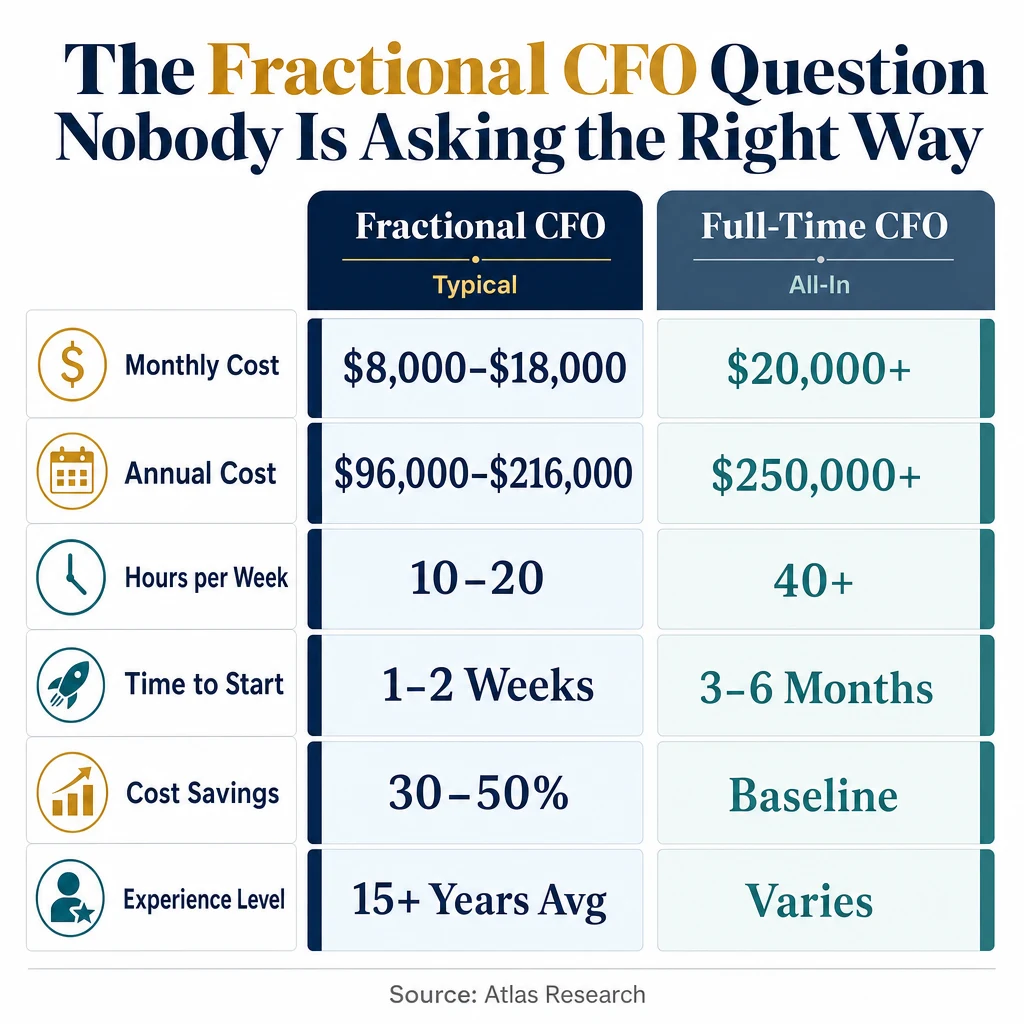
| Metric | Fractional CFO (Typical) | Full-Time CFO (All-In) |
|---|---|---|
| Monthly Cost | $8,000-$18,000 | $20,000+ |
| Annual Cost | $96,000-$216,000 | $250,000+ |
| Hours per Week | 10-20 | 40+ |
| Time to Start | 1-2 Weeks | 3-6 Months |
| Cost Savings | 30-50% | Baseline |
| Experience Level | 15+ Years Avg | Varies |
Where to Read Further
For readers who want to go deeper on the evaluation framework, Profitability Partners' guide to choosing a fractional CFO company offers a detailed breakdown of the six traits that separate the best firms from the rest. For a broader view of the 2026 fractional CFO landscape, Fractional Jobs' platform comparison maps the range of options from self-service directories to white-glove search services. For specific pricing data and engagement structures, FlexExec's fractional CFO framework provides detailed breakdowns by engagement type and industry focus.