


What is the real cost of AI hallucinations for enterprises?
The numbers move fast. According to a widely cited industry estimate, global business losses attributable to AI hallucinations reached $67.4 billion in 2024 roughly $2,130 in damages every second worldwide. That figure, while staggering, represents only documented and attributable losses; the majority of hallucination costs go unreported, buried in rework cycles, legal exposure, and strategic missteps that organizations rarely trace back to their source.
The problem is structural. Large language models do not possess knowledge in the human sense. They base their answers on data patterns, generating plausible-sounding content with full confidence even when that content is factually wrong, misleading, or entirely invented. Unlike a human researcher who might hesitate or qualify an uncertain answer, an AI system will not self-detect its errors before returning a response. FDM Group's 2026 analysis on AI hallucinations describes this as an inherent characteristic of how modern AI tools operate speed without self-correction.
For enterprises, that combination is expensive. When an AI system generates an incorrect financial figure, a fabricated legal citation, or a fabricated safety claim for a product, the error does not announce itself. It flows into investment models, board presentations, regulatory filings, and strategic decisions. By the time the mistake surfaces if it surfaces at all the cost of remediation has compounded.
"When it comes to ghost citations or other AI-generated data that is incorrect and intended to fulfil a query's demands, the responsibility is on the user. This can leave companies open to millions of dollars in liability for errors."
That observation from Economics Online's breakdown of AI error costs cuts to the heart of the enterprise problem. The technology moves faster than the accountability frameworks surrounding it. Organizations deploying AI for research, legal work, finance, or customer service are absorbing the cost of bad decisions, rework, lawsuits, and reputational damage often without any systematic way to catch the errors before they propagate.
How much money is lost to AI hallucinations every day?
Breaking the global figure down into daily increments reveals the scale at which hallucination costs accumulate. A $67.4 billion annual estimate translates to roughly $184 million per day, distributed across every sector where AI systems touch business decisions. The AnythingCounter cost calculator frames this in visceral terms: a running counter estimating cumulative daily losses, drawing on the same 2024 industry estimate to make the per-second pace tangible.
But the daily figure understates the problem for any single organization. Global averages obscure concentration: the sectors most exposed to AI hallucination costs financial services, healthcare, legal, regulatory compliance absorb disproportionately large losses per incident. A single hallucinated analyst report that leads to a bad investment decision, a hallucinated dosage that contributes to patient harm, or a fabricated legal citation that results in sanctions can individually cost more than many organizations' annual AI budgets.
Research from autumn 2025 suggests that up to 45 percent of AI queries return at least some incorrect or misrepresented information. That finding, cited in Economics Online's economics analysis, means that for organizations running hundreds or thousands of AI queries daily, hallucination exposure is not an edge case it is a statistical near-certainty. The question is not whether errors will occur, but when they will matter.
Why are AI hallucinations so expensive for businesses?
The expense of AI hallucinations stems from three compounding factors: plausible correctness, hidden propagation, and downstream liability.
Unlike obvious factual errors that trigger immediate skepticism, AI hallucinations frequently produce content that looks right. The economics analysis notes that hallucinations are particularly difficult to spot in citations of academic or journalistic sources, where the AI creates fake references to meet query demands. A fabricated case citation in a legal brief, a hallucinated statistic in a market analysis, or an invented academic source in a product safety report all share a dangerous quality: they pass a surface review.
Rachit Khanna, an FDM consultant who works as a full-stack developer for a global banking client, describes the practical reality in FDM Group's examination of AI business costs. Khanna uses AI tools routinely for code generation, presentations, and research tasks, but applies a consistent review protocol. "AI is a good tool to use for 70 to 80 percent of the time, but you have to review the output to see if it's accurate or not," he explains. That 20 to 30 percent error rate, applied across thousands of daily queries, represents a substantial verification burden that most organizations have not systematically addressed.
The hidden propagation problem compounds the cost. When an AI generates incorrect data during an intermediate step a financial ratio, a legal citation, a product specification that error may not surface until it has flowed through multiple downstream systems. A hallucinated earnings-per-share figure generated during an internal analysis may reappear in a board presentation, a regulatory filing, and an investor memo before anyone catches the original mistake. The FDM analysis on financial data vulnerabilities specifically notes that errors in AI-generated financial figures flow directly into investment models and strategic decisions when left undetected.
What is the financial cost of AI hallucinations for enterprises and how is it growing?
The trajectory is upward. AI adoption has accelerated rapidly: FDM Group reports that 88 percent of organizations now report regular AI use delivering productivity gains through automation and faster software development. As adoption scales, hallucination exposure scales with it both because more queries generate more errors, and because AI systems are being assigned to higher-stakes decisions.
The productivity paradox is worth examining closely. While 92 percent of workers say AI boosts their productivity, the average employee spends roughly 4.5 hours per week verifying AI outputs, according to data cited in the AnythingCounter analysis. That verification time partially offsets the efficiency gains that make AI adoption attractive. When you factor in the rework cycles triggered by undetected hallucinations, the net productivity benefit narrows considerably.
The legal dimension is adding new cost vectors. The case Moffatt v. Air Canada (2024) established that an airline could be held liable for what its chatbot told a customer. The case Mata v. Avianca (2023) resulted in federal court sanctions for lawyers who filed fabricated AI citations. Both precedents, cited in the AnythingCounter breakdown, point in the same direction: organizations answer for their AI systems' output. Courts are still developing the case law, but the direction is clear. AI hallucinations are transitioning from a hidden productivity problem into a named legal risk, appearing in filings, settlements, and ultimately insurance pricing.
What this means for GenXis, Stripe, Deloitte readers is straightforward: the cost of AI hallucinations is not a future concern or a theoretical risk. It is a present, measurable, and growing line item on enterprise balance sheets. Organizations that deploy AI without verification infrastructure are effectively self-insuring against a known failure mode and the premiums are climbing.
How do you calculate the cost of AI hallucinations?
Calculating hallucination costs requires accounting for multiple damage channels simultaneously. The most direct cost is rework: the time spent identifying an error, rerunning the query, and double-checking the corrected output. The economics analysis notes that unlike human researchers who might self-correct mid-process, AI requires entire queries to be redone and then double-checked by human employees reducing the productivity advantage that justified the AI deployment in the first place.
Beyond rework, there are downstream costs that standard productivity metrics often miss. Legal liability from hallucinated citations or false claims represents a seven-figure exposure category that most organizations have not priced into their AI adoption models. Reputational damage from publicly caught errors a false marketing claim, an incorrect safety assertion, a fabricated research citation can exceed the direct legal costs in industries where trust is the primary product.
A practical calculation framework should include: direct rework hours multiplied by fully loaded labor costs; legal review and potential liability costs weighted by industry exposure; downstream error propagation risk based on how many systems receive AI outputs without secondary verification; and the verification time burden that reduces net productivity gains. Home Business Magazine's hallucination cost calculator offers a starting model for organizations that want to quantify their exposure in concrete dollar terms.
What are the economic impacts of AI errors and hallucinations?
The economic impacts extend across four primary domains: direct financial loss, legal and regulatory exposure, productivity erosion, and competitive disadvantage.
In financial analysis and reporting, AI-generated errors create direct monetary consequences. As FDM Group's analysis describes, when AI misreads financial data to produce a plausible-looking but incorrect earnings-per-share figure, that error can flow into investment models, board presentations, and strategic resource allocation decisions. A single undetected hallucination in a quarterly analysis can misdirect capital for months.
In legal and compliance contexts, hallucinated citations create liability that extends beyond the original error. Economics Online's analysis provides a concrete example: AI may generate false citations to give product research credibility, later subjecting the company to lawsuits alleging it failed to complete actual product research and guarantee product safety. Had humans been doing the data work, or at least double-checking the AI results, the fake citations would have been detected before the product reached the market.
In healthcare, wrong dosage information generated by AI systems has led to documented patient harm. In marketing, AI-generated false claims have drawn regulatory action. These sector-specific impacts compound into an economy-wide productivity drag that standard GDP metrics struggle to capture, because much of the damage is absorbed privately by organizations and surfaces only in litigation, rework, and eroded trust.
Why the verification gap matters and what independent deterministic checks can do
The root challenge is not that AI systems make errors all information systems make errors. The challenge is that AI systems generate errors at machine speed with human-level confidence, and most organizations lack the infrastructure to catch those errors before they propagate into consequential decisions. The average employee spending 4.5 hours per week on AI verification, as cited in AnythingCounter's cost analysis, represents a reactive posture: errors are caught after the fact, during a verification step that was not designed as a quality control gate.
The alternative is structural verification checking AI proposals before they run, not after. This is the approach that tools like GenXis Gavel are designed to enable: independent, deterministic verification that evaluates whether an AI-generated proposal is sound before that proposal executes. Rather than relying on human reviewers to catch hallucinations after the fact, deterministic verification applies a defined check against the AI's output, flagging inconsistencies, fabricated citations, and logical errors before they cause downstream damage.
The 32 percent of organizations that FDM Group identifies as lacking specialist skills required to adopt AI face a compounding problem: not only are they deploying AI systems with known error rates, but they lack the internal expertise to build the verification infrastructure those error rates demand. Deterministic verification tools that operate independently of specialist AI knowledge can close that gap making hallucination protection accessible to organizations regardless of their internal technical capacity.
What this means for organizations deploying AI at scale
The practical answer is to match verification effort to stakes. As the AnythingCounter analysis notes, drafts and brainstorming can tolerate error the cost of a hallucinated phrase in an internal memo is negligible. Contracts, medical protocols, financial projections, and published work cannot. The verification protocol should scale with the consequences of getting it wrong.
For organizations running AI across high-stakes workflows anything touching legal compliance, financial decisions, regulatory filings, or customer-facing communications the question is no longer whether to verify AI outputs, but how to verify them at the speed and scale that AI deployment demands. Human review alone cannot scale. Deterministic, automated verification that runs independently of the AI system generating the output is the structural answer that the hallucination problem requires.
The $67.4 billion annual estimate represents documented losses. The undocumented losses the strategic decisions made on hallucinated data, the legal exposures created by fabricated citations, the customer relationships damaged by AI-generated false claims are almost certainly larger. Organizations that treat verification as an afterthought are paying a hidden tax on every AI deployment. Those that build verification into the workflow at the outset are positioned to capture AI's productivity gains without absorbing its error costs.
Where to read further
- Forbes Tech Council's analysis of enterprise AI hallucination costs examines the gap between AI ambition and underlying system readiness as adoption scales
- Economics Online's breakdown of AI error costs and liability exposure covers the trade-off between AI speed and error rates in business contexts
- AnythingCounter's hallucination cost calculator and legal precedent analysis tracks real-time global cost estimates and examines case law establishing organizational liability
- FDM Group's examination of AI hallucination impacts across business functions includes practitioner perspective on verification practices in enterprise environments
- Home Business Magazine's global business hallucination cost calculator interactive tool for organizations seeking to quantify their own exposure
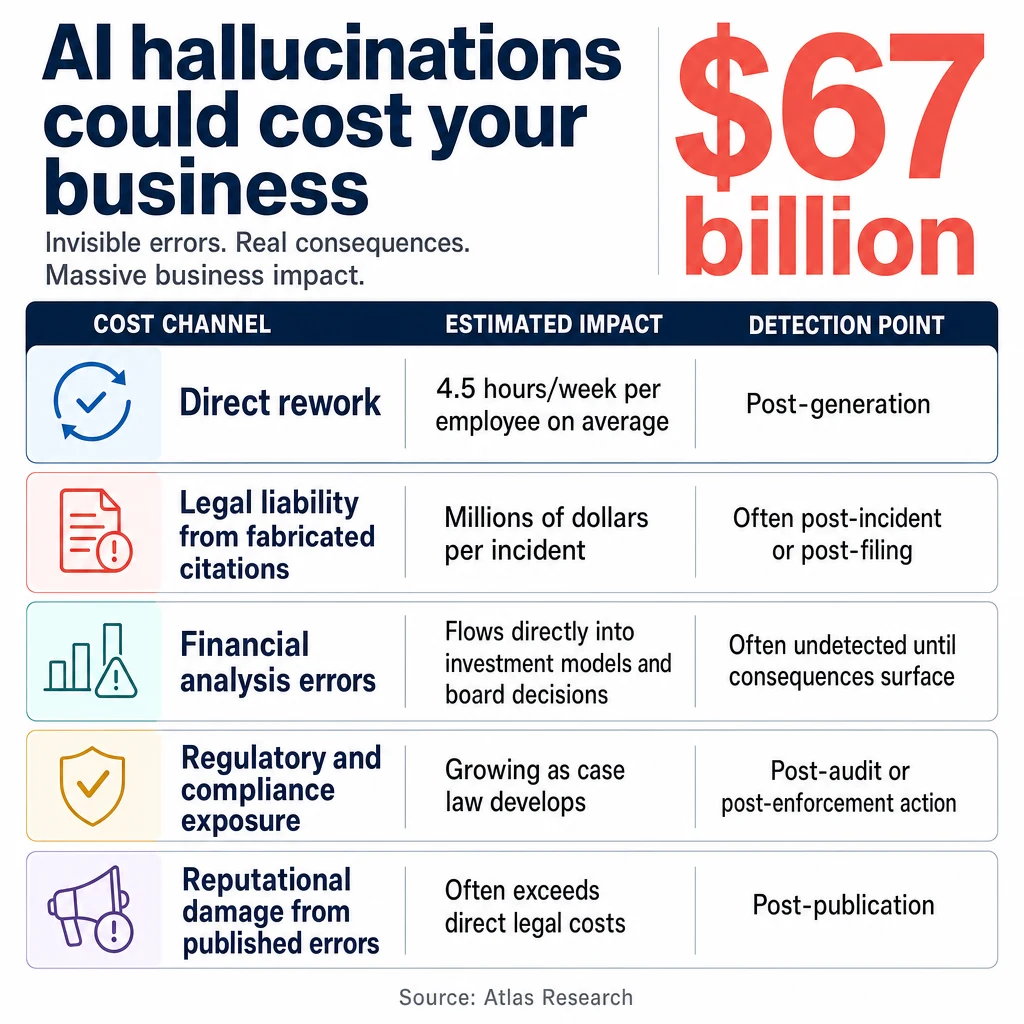
| Cost Channel | Estimated Impact | Detection Point |
|---|---|---|
| Direct rework (query redo + human double-check) | 4.5 hours/week per employee on average | Post-generation |
| Legal liability from fabricated citations | Millions of dollars per incident | Often post-incident or post-filing |
| Financial analysis errors | Flows directly into investment models and board decisions | Often undetected until consequences surface |
| Regulatory and compliance exposure | Growing as case law develops | Post-audit or post-enforcement action |
| Reputational damage from published errors | Often exceeds direct legal costs | Post-publication |
Why this matters now
The window for treating AI hallucination costs as optional is closing. Legal precedent has established organizational accountability. Adoption rates have reached the point where hallucination exposure is statistically guaranteed across large query volumes. And the verification tools needed to address the problem deterministic, independent checks that evaluate proposals before execution are available today.
Organizations that treat verification as a cost center today will find it becomes a competitive differentiator tomorrow. Not because verification itself is a differentiator, but because the errors it prevents the legal liabilities, the strategic missteps, the reputational damage are the kind of events that reshape market positions. The question is not whether AI hallucinations will cost your organization money. The question is whether you will pay to catch them, or pay for the consequences of missing them.